
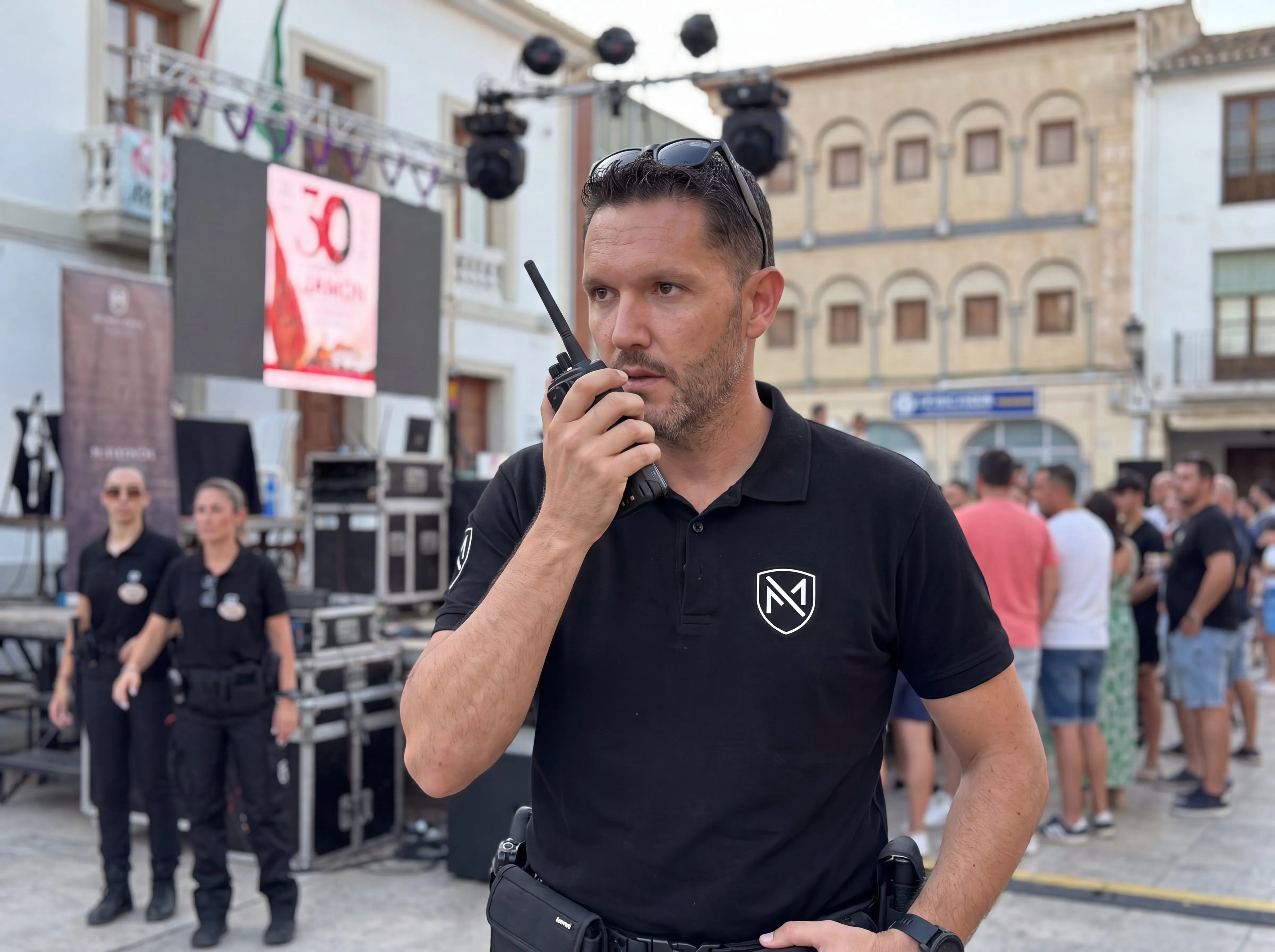
A successful event is measured not only by attendance or content, but by what does not happen: no endless queues, no incidents, no moments of tension. Behind that apparent normality lies a well-designed security plan. Let’s look at how private security is structured for events.
Why security is part of an event’s success
When an event lacks an adequate security plan, problems appear quickly: crowding at entrances, unauthorised people in restricted areas, conflicts between attendees, or delays in responding to incidents. These failures not only put people at risk; they also affect the organiser’s reputation.
A professional security service provides three key elements:
- Prevention before the incident occurs.
- Rapid response when a situation arises.
- Peace of mind so that organisers and attendees enjoy the event.
The phases of event security
1. Prior analysis
Everything starts before the day of the event. The security team evaluates:
- The venue: number of entrances, capacity, sensitive areas, emergency exits.
- The attendee profile: general public, public figures, minors, VIP staff.
- The type of event: corporate conference, concert, trade fair, audiovisual shoot, gala.
- The specific risks: prior threats, weather conditions, schedule.
With this information a bespoke device is designed, not a standard solution.
2. Access control
The entrance is the first critical point. Effective control combines:
- Ticket or credential verification in an agile way, without creating queues.
- Metal detectors or manual checks depending on the required security level.
- List and accreditation management for staff, press and authorities.
- Visible, prepared personnel to resolve incidents with discretion.
Good access control goes unnoticed: attendees enter smoothly and without friction.
3. Interior surveillance
Once inside, the team maintains a strategic presence:
- Fixed posts in sensitive areas (stage, VIP zone, catering, storage).
- Mobile patrols that tour the venue regularly.
- Radio coordination to respond to any incident in seconds.
- Collaboration with the organiser to adapt to programme changes.
4. Incident response
No plan eliminates 100% of risk. What matters is being prepared. The security team knows the protocols to:
- Identify and isolate conflicts before they escalate.
- Coordinate partial or total evacuations if necessary.
- Contact emergency services and law enforcement.
- Document incidents for later analysis.
Event types that most need professional security
Although any gathering of people benefits from security measures, certain formats make the service especially relevant:
- Corporate and institutional events with authorities or executives.
- Shoots and audiovisual productions with well-known artists.
- Trade fairs and congresses with high attendee volume.
- Galas and award ceremonies where discretion with public figures is required.
- Private events with restricted access.
The importance of coordination with the organiser
Security does not work in isolation. The best result comes when the security team integrates into the event organisation, knows the programme, coordinates with production and catering, and maintains fluid communication with the event lead.
That prior coordination is often the difference between a minor incident resolved in seconds and a problem that escalates to ruin the experience.
Conclusion
Event security is not an additional expense: it is an investment in the attendee experience and the organiser’s peace of mind. A professional, planned and coordinated device allows the event to run normally and lets people focus on what matters: the content and the relationships.
If you are organising an event in Seville or Andalusia, see our event security service or contact us early enough to design the bespoke security plan.
Informational content that does not constitute legal advice. See our editorial policy.