
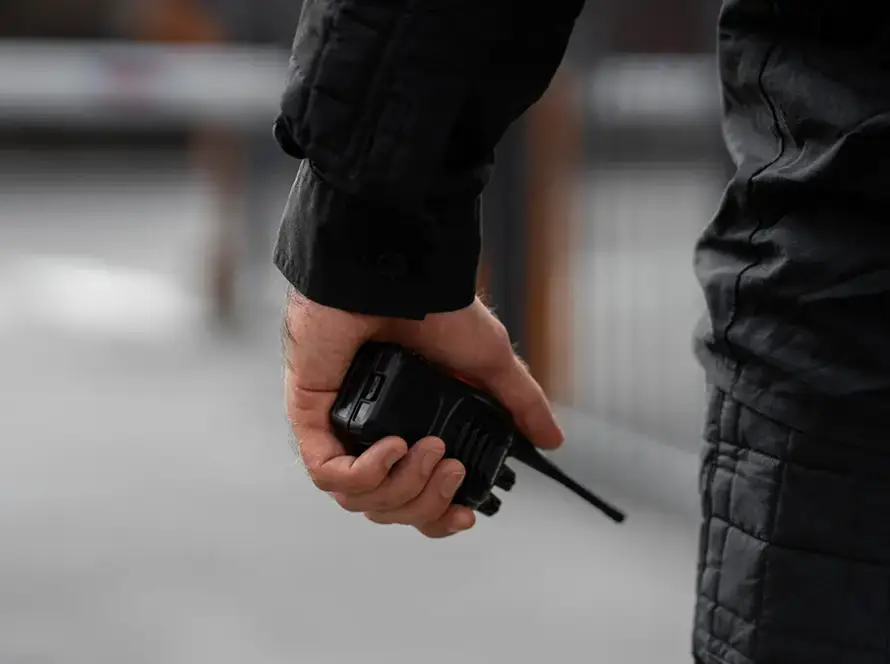
The private escort is one of the best-known and, at the same time, most misunderstood figures in private security. The cinematic image of the bodyguard who solves everything with action is far from the reality of a licensed professional. Let’s see what a private escort actually does and when it makes sense to have one.
What a private escort is
A private escort is a security professional licensed by the Ministry of the Interior with specific training in personal protection. Their goal is not only to react to an assault, but to prevent that assault from happening in the first place.
Unlike a security guard, who protects spaces and facilities, the escort protects people. Their work revolves around the physical integrity of an individual during transfers, public appearances or risk situations.
Functions of the escort
Prior study and planning
Before any service, the escort analyses:
- The risk level of the protected person.
- Their usual routines and transfers.
- Alternative routes and sensitive points.
- The protocols according to the environment (public event, trip, residence).
This planning phase is often the most important part of the work: most incidents are avoided through preparation, not reaction.
Protection during transfers
The escort accompanies the protected person in their movements, ensuring:
- Safe routes and previously verified paths.
- Defensive driving when the escort also acts as driver.
- Environment control at each stop.
- Detection of surveillance or suspicious behaviour.
Surveillance at public and private events
At events, galas, meetings or appearances, the escort maintains a discreet but constant presence. Their role is to go unnoticed by others without losing sight of the protected person, identifying threats before they materialise.
Coordination with law enforcement
When the situation requires it, the escort coordinates their action with police forces. This collaboration is common at events with authorities or when the protected person also has official protection.
Intervention in incidents
If, despite all prevention, a risk situation occurs, the escort is trained to:
- React immediately to assault or intrusion attempts.
- Remove the protected person from the danger zone.
- Contain the situation until law enforcement arrives.
- Provide first aid if necessary.
When to hire an escort
You don’t need to be a public figure to benefit from personal protection. The most common cases are:
- Businesspeople and executives handling sensitive information or high-value transactions.
- Public figures exposed to media attention or followers.
- People with personal, family or professional threats or conflicts.
- High-risk transfers or movements of valuables with people.
- Witnesses or people involved in sensitive judicial proceedings.
- Events requiring absolute discretion with invited figures.
The training required by law
A private escort is not a security guard with expanded responsibilities: it is a specific licence. To obtain it you must:
- Be a licensed security guard for at least two years.
- Pass the private escort specialisation course at an authorised centre.
- Accredit training in self-protection, defensive driving, critical situation control, protection techniques and first aid.
- Obtain the specific licence from the Ministry of the Interior.
To this is added, in many cases, a weapons licence for high-security services.
Conclusion
A private escort is a highly trained professional whose value lies not in force, but in prevention, planning and discretion. Their work is noticed in what does not happen: in the incident that is avoided, in the situation that is controlled before it escalates, in the peace of mind of someone who knows they are protected.
If you are in a situation that requires personal protection, the most advisable course is to contact a licensed team to study your case and design a bespoke plan, with full confidentiality.
Informational content that does not constitute legal advice. See our editorial policy.